

Can rf plasma equipment be used for surface treatment?
Dec 11, 2025
In the realm of modern manufacturing and materials science, surface treatment plays a pivotal role in enhancing the performance, durability, and functionality of various materials and products. One technology that has gained significant attention in recent years for surface treatment applications is RF (Radio Frequency) plasma equipment. As a supplier of RF plasma equipment, I am often asked about the feasibility and effectiveness of using our equipment for surface treatment. In this blog post, I will delve into the details of RF plasma technology, its applications in surface treatment, and the benefits it offers.
Understanding RF Plasma Technology
RF plasma is generated by applying a radio frequency electromagnetic field to a gas or a mixture of gases in a vacuum chamber. When the RF energy is introduced, the gas molecules are ionized, creating a plasma state consisting of ions, electrons, and neutral particles. This plasma is highly reactive and can be used to modify the surface properties of materials in a controlled manner.
The key advantage of RF plasma technology lies in its ability to generate a low-temperature plasma, which is suitable for treating heat-sensitive materials. Unlike traditional high-temperature surface treatment methods, RF plasma treatment can be carried out at relatively low temperatures, minimizing the risk of thermal damage to the substrate. Additionally, RF plasma can be precisely controlled in terms of its composition, density, and energy, allowing for tailored surface modifications to meet specific application requirements.
Applications of RF Plasma Equipment in Surface Treatment
Cleaning and Activation
One of the most common applications of RF plasma equipment is surface cleaning and activation. Contaminants such as oils, greases, and oxides can significantly affect the adhesion and bonding properties of materials. RF plasma treatment can effectively remove these contaminants by bombarding the surface with high-energy ions and radicals, breaking down the organic and inorganic compounds and leaving a clean and activated surface.

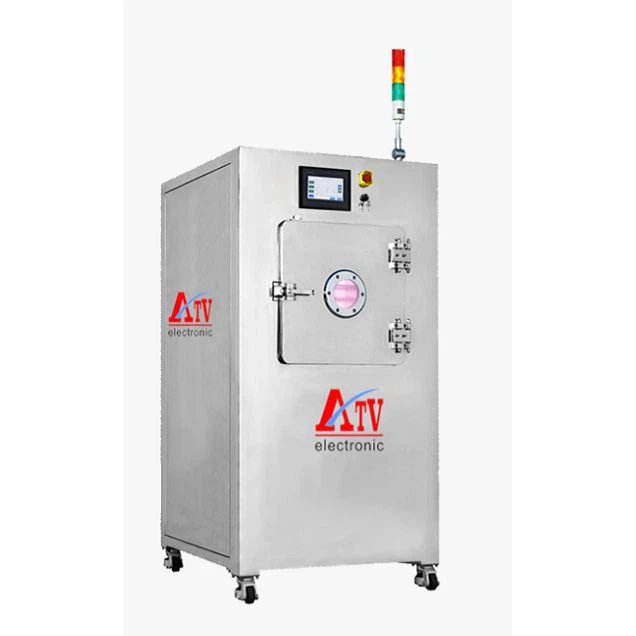
This process is particularly useful in industries such as electronics, where clean and activated surfaces are essential for reliable bonding and soldering. For example, in the manufacturing of printed circuit boards (PCBs), RF plasma treatment can be used to remove residues from the surface of the board, improving the adhesion of solder masks and components. LCD RF Plasma Equipment can also be employed to clean and activate the surfaces of LCD panels, enhancing the display quality and reliability.
Etching and Patterning
RF plasma equipment can also be used for etching and patterning of materials. By selectively removing material from the surface, plasma etching can create precise patterns and structures on the substrate. This is widely used in the semiconductor industry for the fabrication of microelectronic devices such as integrated circuits and microelectromechanical systems (MEMS).
In semiconductor manufacturing, RF Plasma Equipment for Semiconductor Applications is used to etch away unwanted layers of silicon, metals, and dielectrics, creating the desired circuit patterns. The ability to control the etching rate and selectivity of the plasma allows for high-precision patterning, enabling the production of smaller and more complex semiconductor devices.
Coating and Deposition
Another important application of RF plasma equipment is surface coating and deposition. Plasma-enhanced chemical vapor deposition (PECVD) is a technique that uses RF plasma to deposit thin films of various materials onto the surface of a substrate. This process can be used to create protective coatings, anti-reflective coatings, and functional thin films with specific properties.
For example, in the automotive industry, RF plasma deposition can be used to apply hard and wear-resistant coatings to engine components, improving their durability and performance. In the optical industry, anti-reflective coatings can be deposited on lenses using PECVD, reducing glare and improving the optical clarity. Vacuum Inline RF Plasma Equipment is often used for continuous coating and deposition processes, enabling high-throughput production.
Surface Modification
RF plasma treatment can also be used to modify the surface properties of materials, such as wettability, surface energy, and biocompatibility. By introducing specific functional groups or altering the surface morphology, plasma treatment can improve the adhesion, printability, and compatibility of materials with other substances.
In the medical industry, RF plasma treatment can be used to modify the surface of medical devices to enhance their biocompatibility. For example, plasma treatment can be used to introduce hydrophilic or hydrophobic groups on the surface of implants, improving their interaction with biological tissues and reducing the risk of rejection. In the packaging industry, plasma treatment can be used to improve the printability and adhesion of inks and labels on plastic and paper substrates.
Benefits of Using RF Plasma Equipment for Surface Treatment
Precise and Controlled Treatment
RF plasma equipment offers precise control over the treatment parameters, such as plasma density, energy, and composition. This allows for tailored surface modifications to meet specific application requirements, ensuring consistent and reproducible results. The ability to control the treatment process also minimizes the risk of over-treatment or under-treatment, reducing waste and improving product quality.
Environmentally Friendly
RF plasma treatment is a dry process that does not require the use of hazardous chemicals or solvents. This makes it an environmentally friendly alternative to traditional wet chemical surface treatment methods. Additionally, the low-temperature operation of RF plasma equipment reduces energy consumption and greenhouse gas emissions, contributing to a more sustainable manufacturing process.
Versatility
RF plasma equipment can be used to treat a wide range of materials, including metals, plastics, ceramics, and composites. This versatility makes it suitable for various industries and applications, from electronics and semiconductors to automotive and medical. The ability to treat different materials with a single piece of equipment simplifies the manufacturing process and reduces the need for multiple treatment systems.
Cost-Effective
Although the initial investment in RF plasma equipment may be higher than some traditional surface treatment methods, the long-term cost savings can be significant. RF plasma treatment is a fast and efficient process that can reduce production time and labor costs. Additionally, the improved product quality and performance resulting from plasma treatment can lead to fewer rejects and rework, further reducing costs and improving profitability.
Conclusion
In conclusion, RF plasma equipment can indeed be used for surface treatment, offering a wide range of applications and benefits. From cleaning and activation to etching, coating, and surface modification, RF plasma technology provides a precise, controlled, and environmentally friendly solution for enhancing the surface properties of materials. As a supplier of RF plasma equipment, we are committed to providing high-quality products and technical support to our customers, helping them to achieve their surface treatment goals.
If you are interested in learning more about our RF plasma equipment or discussing your specific surface treatment needs, please do not hesitate to contact us. Our team of experts will be happy to assist you in finding the most suitable solution for your application.
References
- "Plasma Surface Treatment: Principles and Applications" by Michael Stamate and Stefanos Konstantinidis
- "Handbook of Plasma Processing Technology: Fundamentals, Etching, Deposition, and Surface Interactions" edited by James R. Roth
- "Plasma Technology for Surface Modification and Coating" by Jürgen Winter and Hans Jürgen Maier